“We need to improve the process.”
But is the process still designed for the work the organization actually needs to perform?
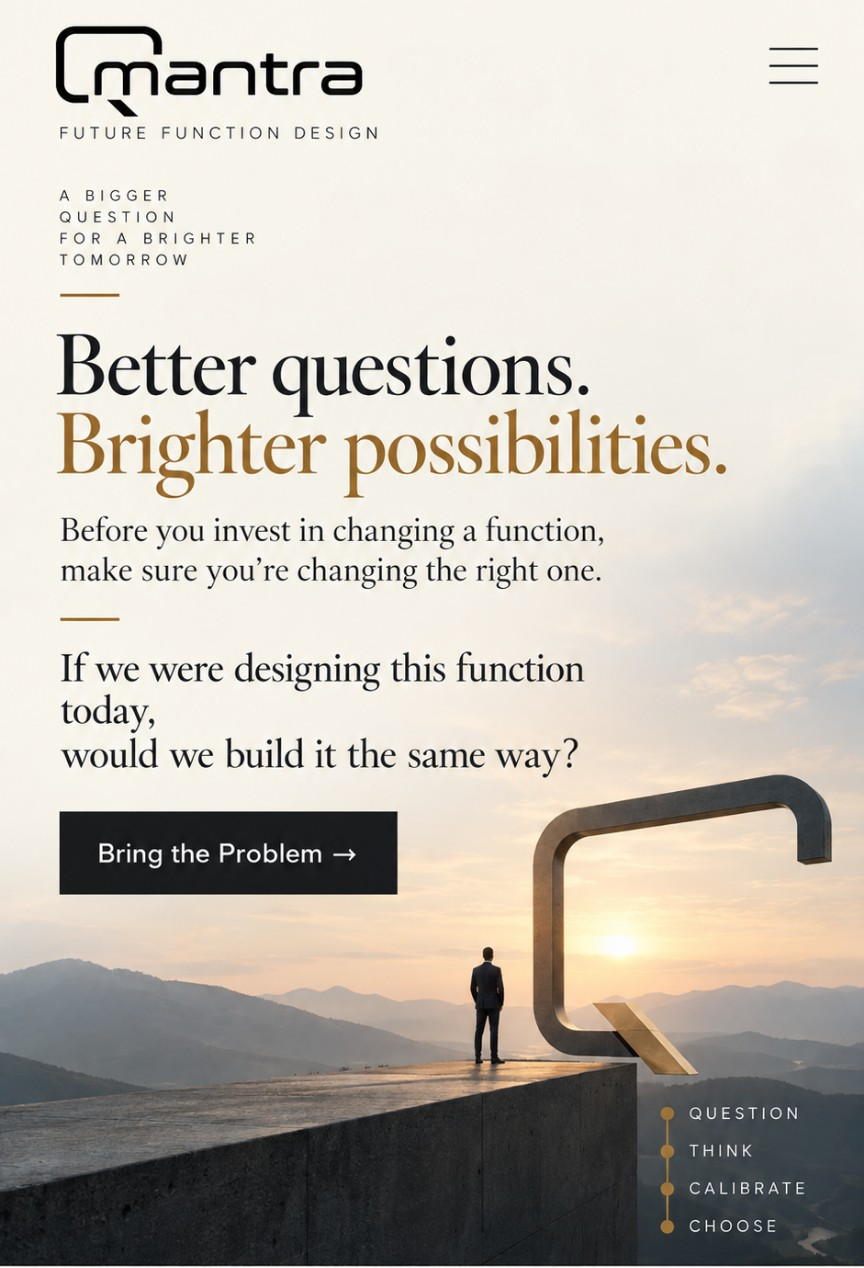
Before you invest in changing a function,
make sure you’re changing the right one.
If we were designing this function today,
would we build it the same way?
But is the process still designed for the work the organization actually needs to perform?
Before automating today's work, question whether tomorrow needs the same work at all.
Is capacity really the constraint — or is the function itself creating the demand?
Changing reporting lines may not change the underlying function.
What does the organization actually need this function to accomplish?
Future Function Design is about deciding how an organization should perform an essential purpose in the future — before optimizing how it performs it today.
Make the assumption visible.
Understand what the function is really trying to accomplish.
Read the function across system, human and future conditions.
Examine plausible future configurations.
Give leadership the evidence and implications needed to decide.
The first reading is not “How good is the function?” It is “What deserves to be questioned before we design its future?”
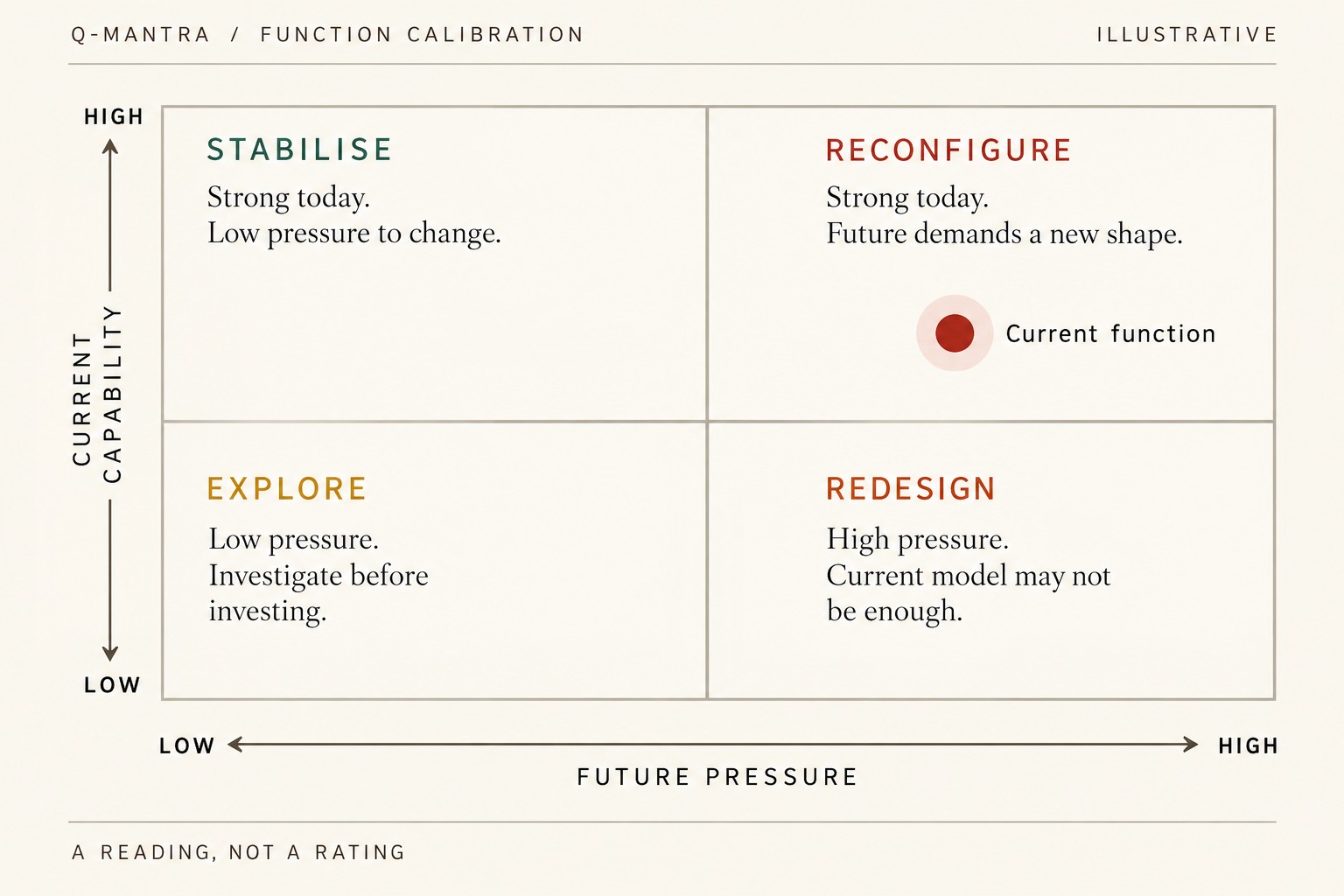
Before committing to a redesign, challenge what might change.
What if automation eliminates a significant portion of today’s work?
What if demand doubles — but capacity cannot?
What if the control model itself needs to change?
What if the skills and people the function depends on change?
What if the cost of maintaining today’s function exceeds the value it creates?
Quality · Process · Six Sigma · Metrics · Governance · Simulation
Psychology · Behaviour · Capability · Decision dynamics · Adoption
The question is not which lens wins.
It is what the function requires us to see.
What does the function cost today?
What value does it create?
What changes if demand or technology shifts?
What does the alternative design cost?
What is the cost of not changing?
Clarify what the organization is actually trying to accomplish.
Read the current function across system, human and future conditions.
Challenge assumptions and examine alternatives.
Give leadership evidence and implications needed for the decision.
Continuous improvement taught us how to improve the system. Six Sigma taught us to understand variation. Metrics established evidence. Simulation lets us explore possible futures. Psychology and NLP help us understand humans inside the system. Quality and governance help sustain performance.
These lenses led to a deeper question:
What if the biggest opportunity is not to improve the existing system — but to reconsider what the system should become?
If there is a function your organization is about to automate, restructure, scale, control, reduce or replace — bring the problem.
Question the Function →